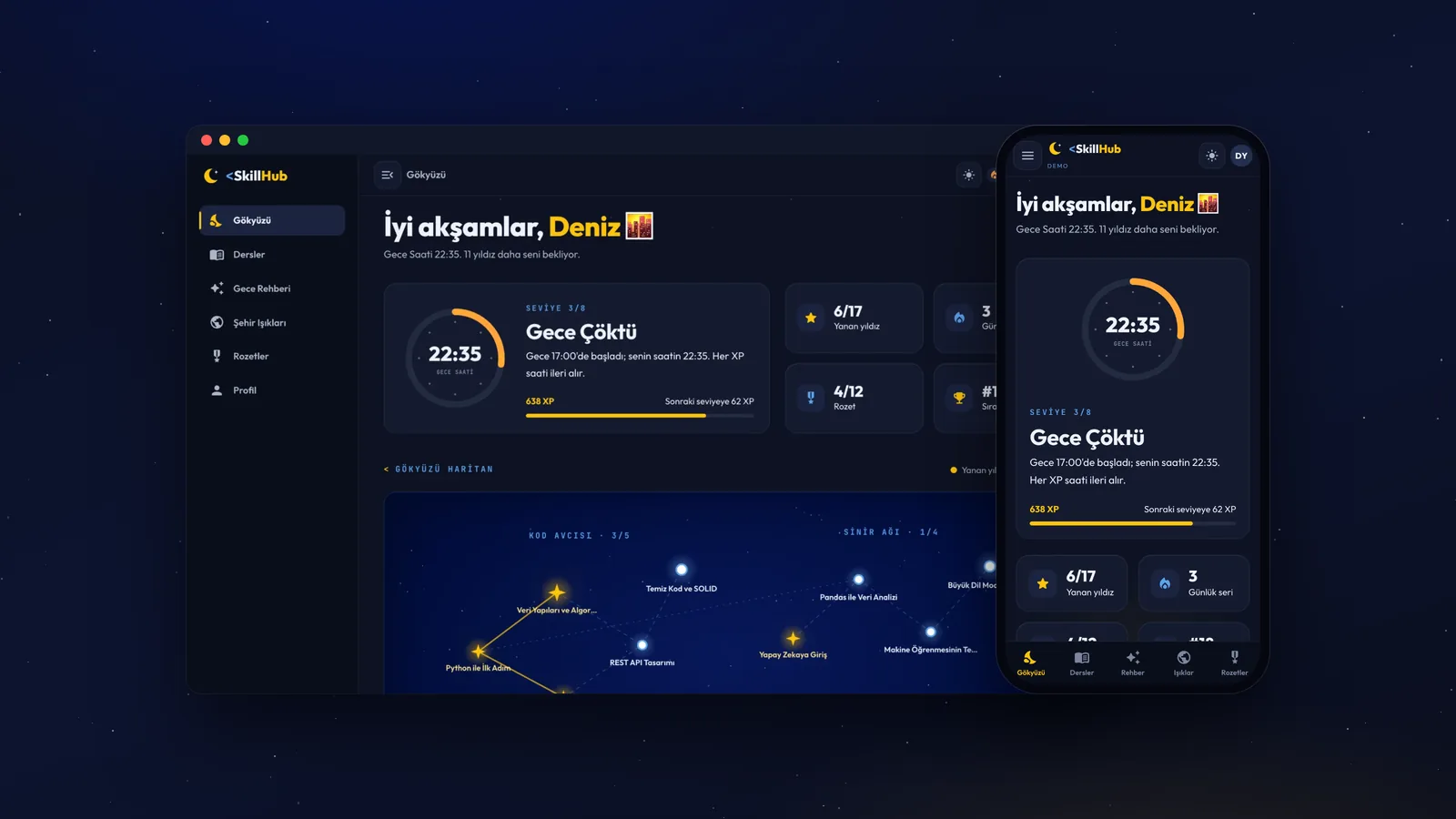
Code Night Trabzon 1st Place & All-Star Finalist Project
Turkcell SkillHub
A night-themed, gamified digital skills platform
My two-person team built this project overnight at Turkcell Code Night 2025 in Trabzon and took first place; after the competition I rewrote it from scratch. Every lesson is a star and every topic a constellation: pass a quiz and your star lights up, and the XP you earn moves your Night Clock from 17:00 toward dawn. Behind it is a layered Java 25 and Spring Boot 4 API with PostgreSQL. In the live demo you can open a ready-made learner profile with one click and try every module.
- Technologies
- Java 25
- Spring Boot 4
- PostgreSQL 17
- Flyway
- React 19
- TypeScript
- Material UI
- TanStack Query
- Docker
- Claude API
- My role At Turkcell Code Night 2025 in Trabzon my teammate Ayşe Mandıralı and I were a two-person team, and I was the team captain. After the competition I rewrote the project from scratch: I decided the architecture, the data model, the game rules and the design language, and tried every change in the browser before accepting it. I wrote a significant part of the code with an AI assistant (Claude Code), under rules I set.
What I did
- What won us the hackathon was the idea and the demo; the code was not production-ready. I opened the project like a code review: sign-in lived in the browser, the leaderboard invented names, XP could be farmed forever and an API key had been committed to the repository. Instead of patching it, I rewrote the database, the backend and the interface from scratch and kept the screenshots of that night in the repository as a memento.
- XP is kept in an append-only ledger, not in a counter. Totals, levels and rankings are derived from that ledger with SQL window functions on every read, so there is no copied score that can drift away from the truth.
- Retaking a quiz only pays the XP above your previous best score. Grading, the attempt, XP and badges are written in one transaction, and because I lock the learner's row with FOR UPDATE, a double-click cannot pay the same improvement twice.
- Correct answers never reach the browser; grading happens on the server in a pure domain function. The database guards the rules too: a partial unique index guarantees one correct option per question, and two simultaneous sign-ups with the same email end in a 409, not a 500.
- Claude writes the Night Guide's suggestions, but the model only sees the learner's real progress and every suggestion is checked against lessons the learner can actually open. If the model refuses, fails or no key is configured, a deterministic rule engine answers instead.
- I did not insert demo data by hand: 30 fictional learners replay four weeks of history through the real quiz service, so XP, streaks, badges and rankings come from the same code as live traffic.
- I measured the colours from the official Code Night visuals and built a design language on them. The first design used saturated navy everywhere and was tiring to use for long; with “Sakin Gece” (Calm Night) I moved the working surfaces to calm tones, kept the navy only for the sky windows and gave glow only to things that are earned. The dark and light themes switch through CSS variables without re-rendering the page.
- On free hosting the backend fell asleep and the database was deleted. I wrote a demo layer that answers the same API contract in the browser, so the live demo opens instantly, and this code never enters the real API build. For anyone who wants the real system, one command is enough: docker compose up --build.
- I applied Clean Architecture on both sides: the backend's business rules are plain Java with no Spring dependency, and every screen of the interface lives in its own folder. No hand-written file exceeds 300 lines, and I documented every decision with its reasons and trade-offs in the repository's docs folder.
The problem
Young people start learning software, AI or cybersecurity with enthusiasm, but it fades quickly: they don't know where to continue among scattered resources, they can't see their progress and their effort doesn't feel rewarded. That was exactly the Code Night case: a platform to watch lessons, take quizzes, earn badges and track progress.
What it offers
Looking at the sky, a learner sees at a glance where they are and which star comes next. Prerequisite lines show the path, the Night Guide gives personal suggestions, and XP, streaks, secret badges and their city glowing on the map of Türkiye turn learning into a game. After every quiz they see why an answer was wrong, so a retake is about learning, not points.
-
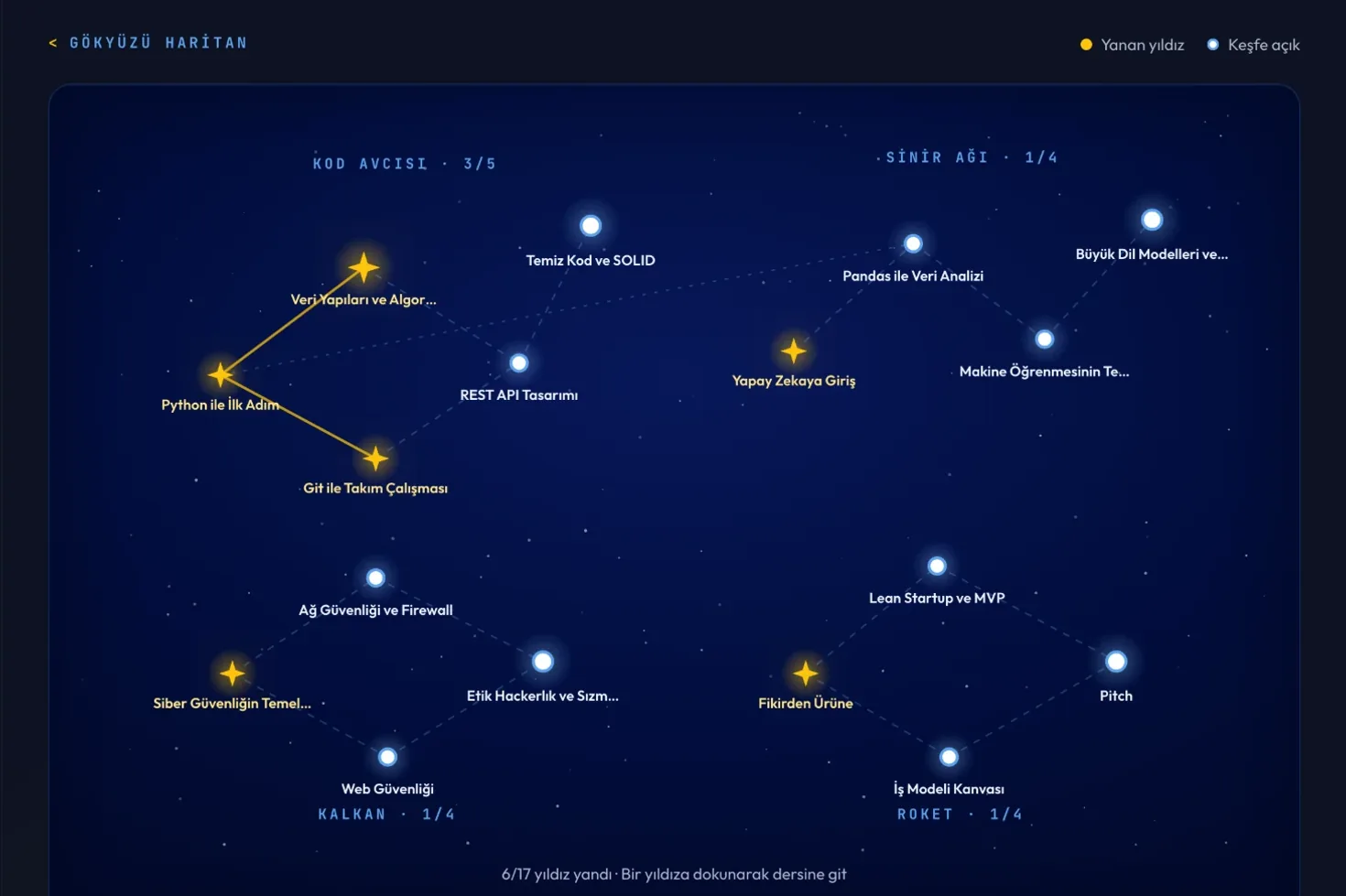
The sky map: every lesson is a star and every topic a constellation; the lines show prerequisites -
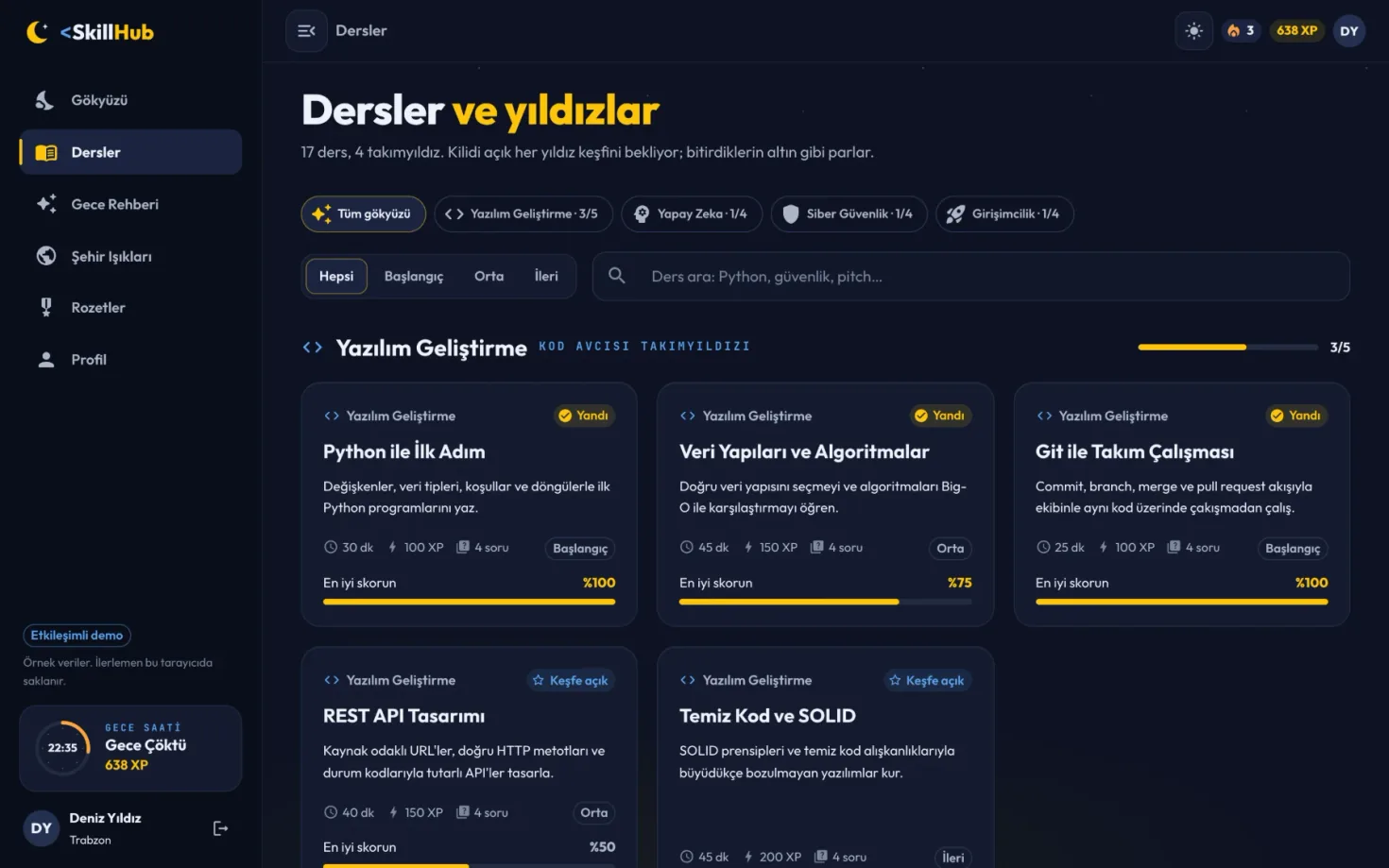
The lesson catalogue: filters by constellation and difficulty, with the best score on every lesson -
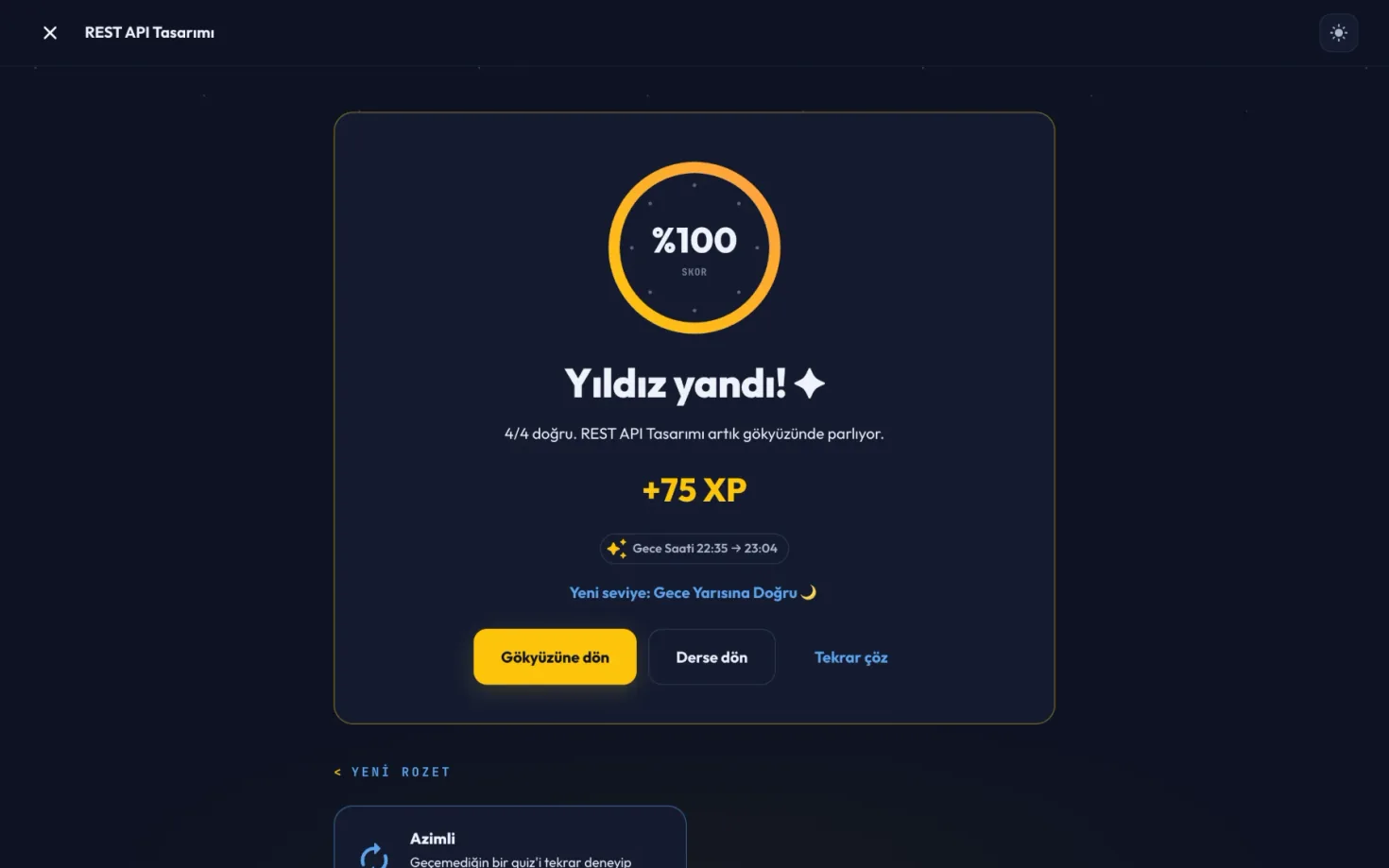
Quiz result: +75 XP, the Night Clock moving from 22:35 to 23:04 and a new level -
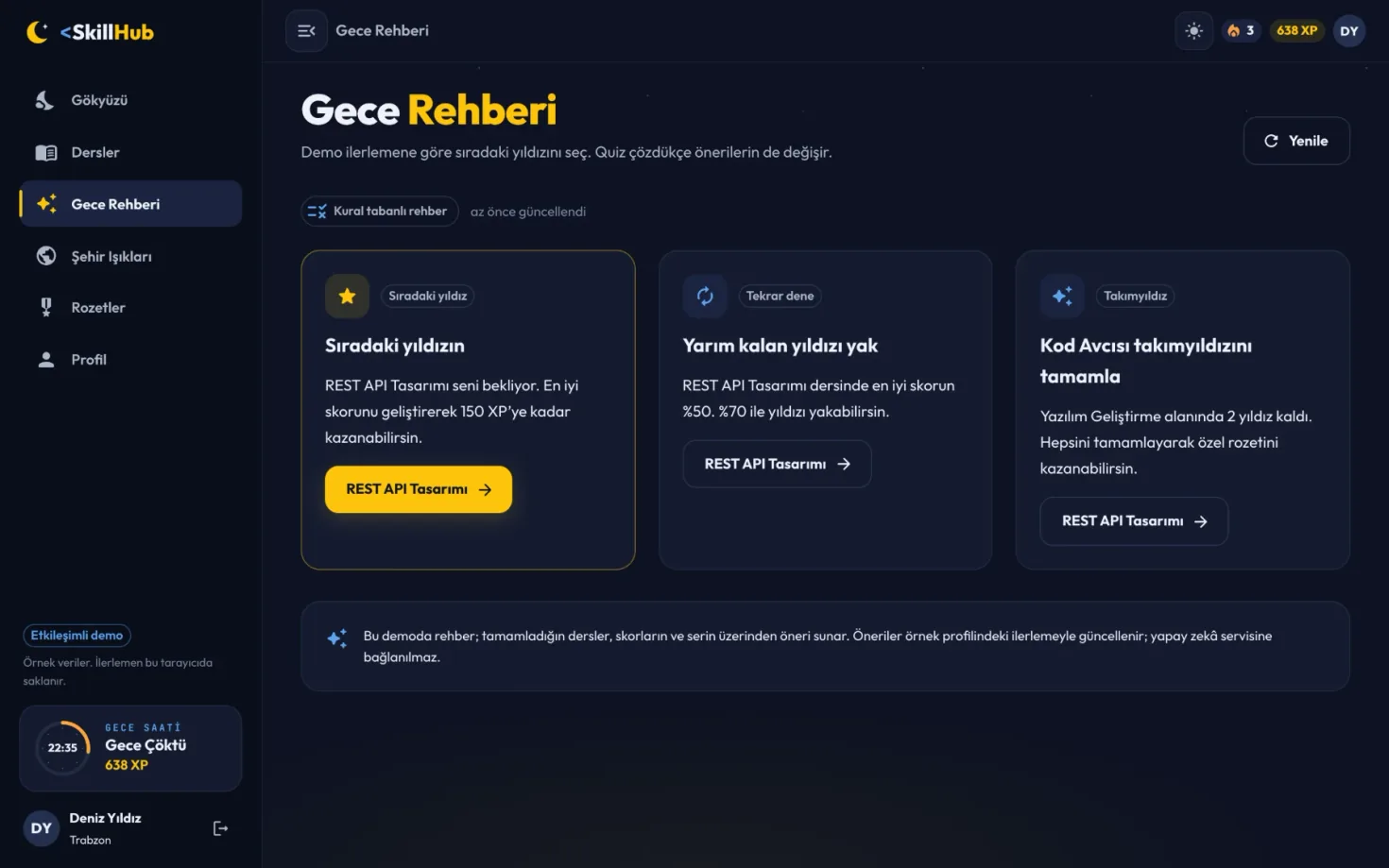
The Night Guide: three personal suggestions built from the learner's real progress -
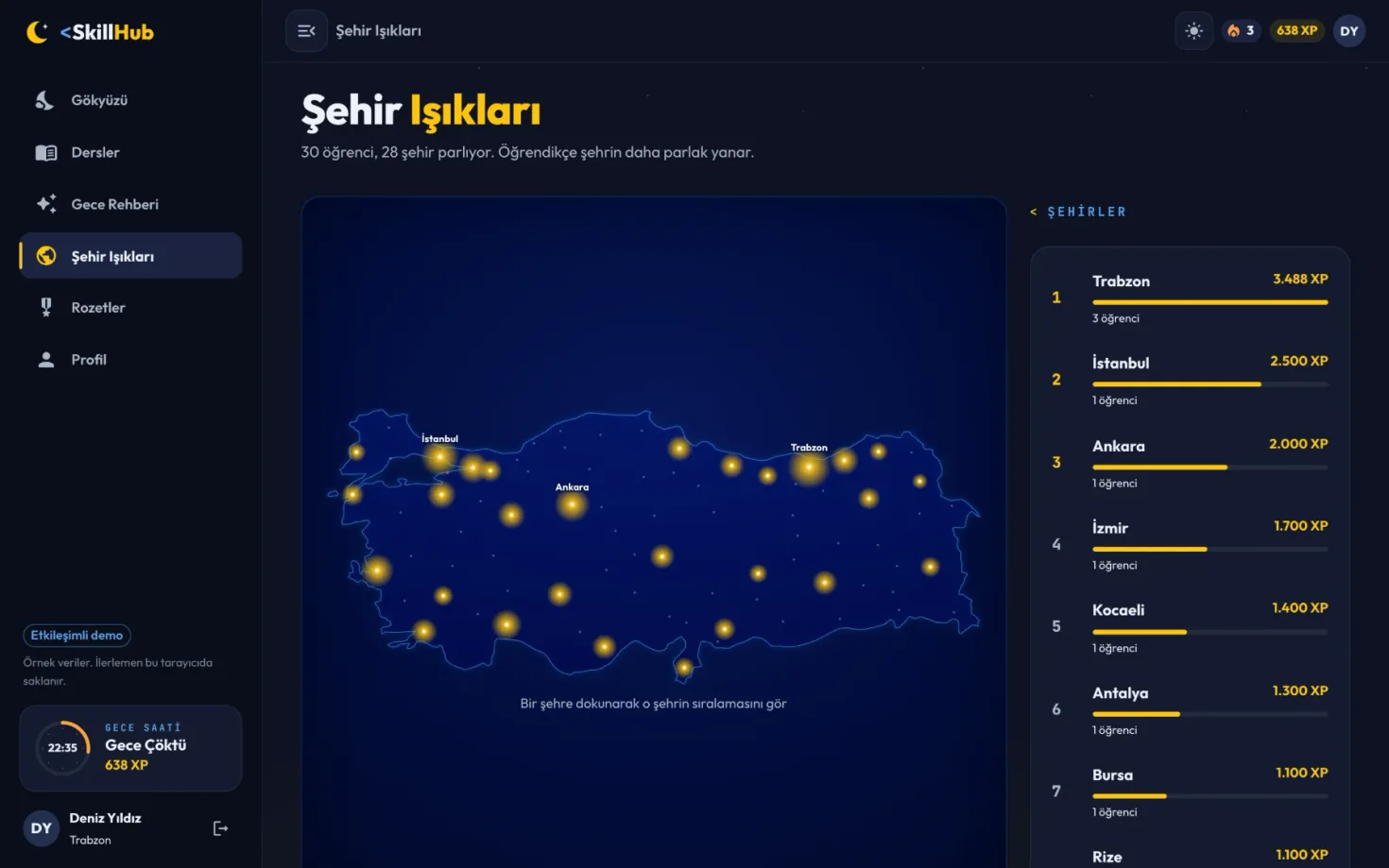
City Lights: a night map of all 81 provinces, where cities glow with their learners' XP -
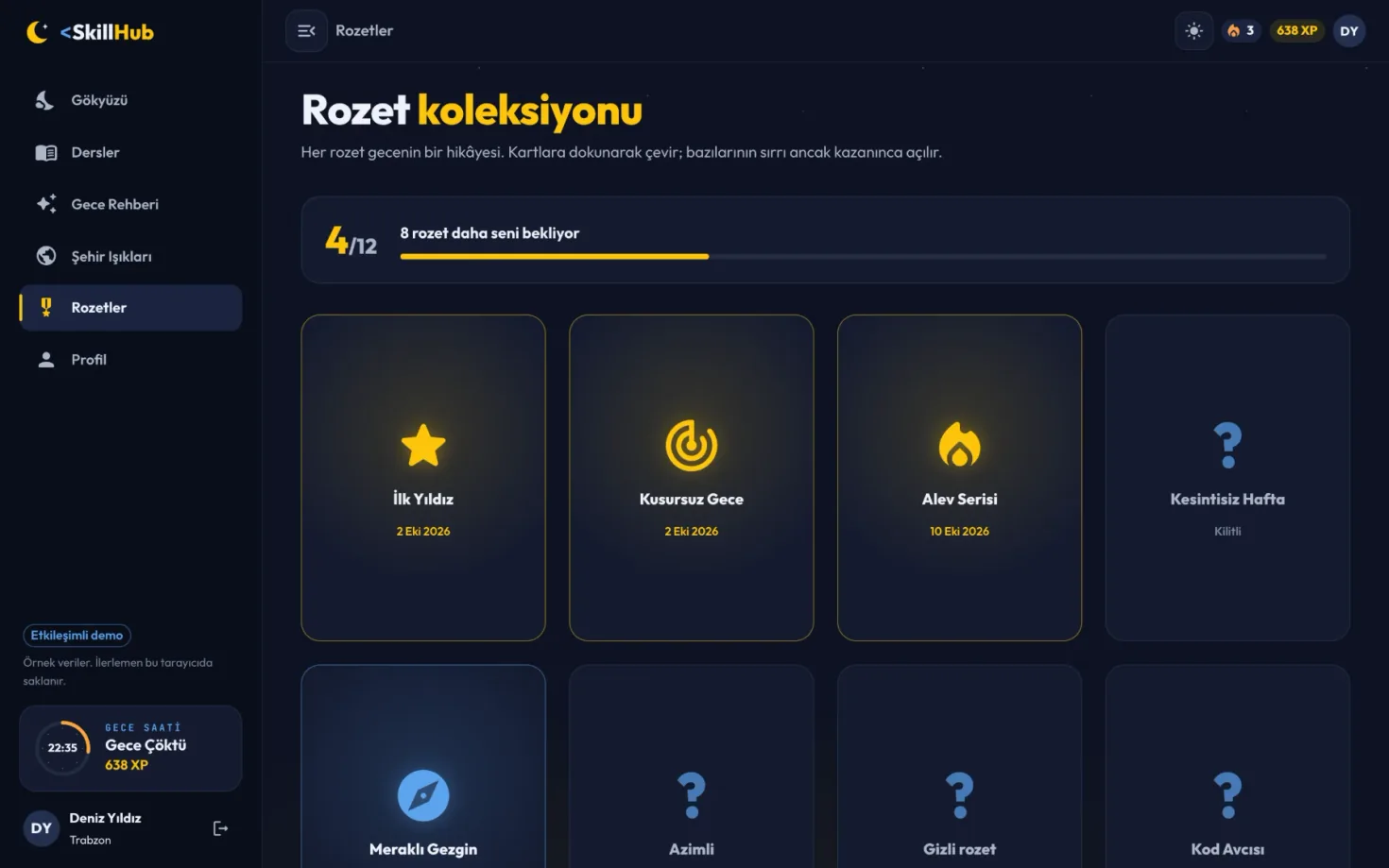
The badge collection: 12 cards; secret badges keep their story hidden until earned -
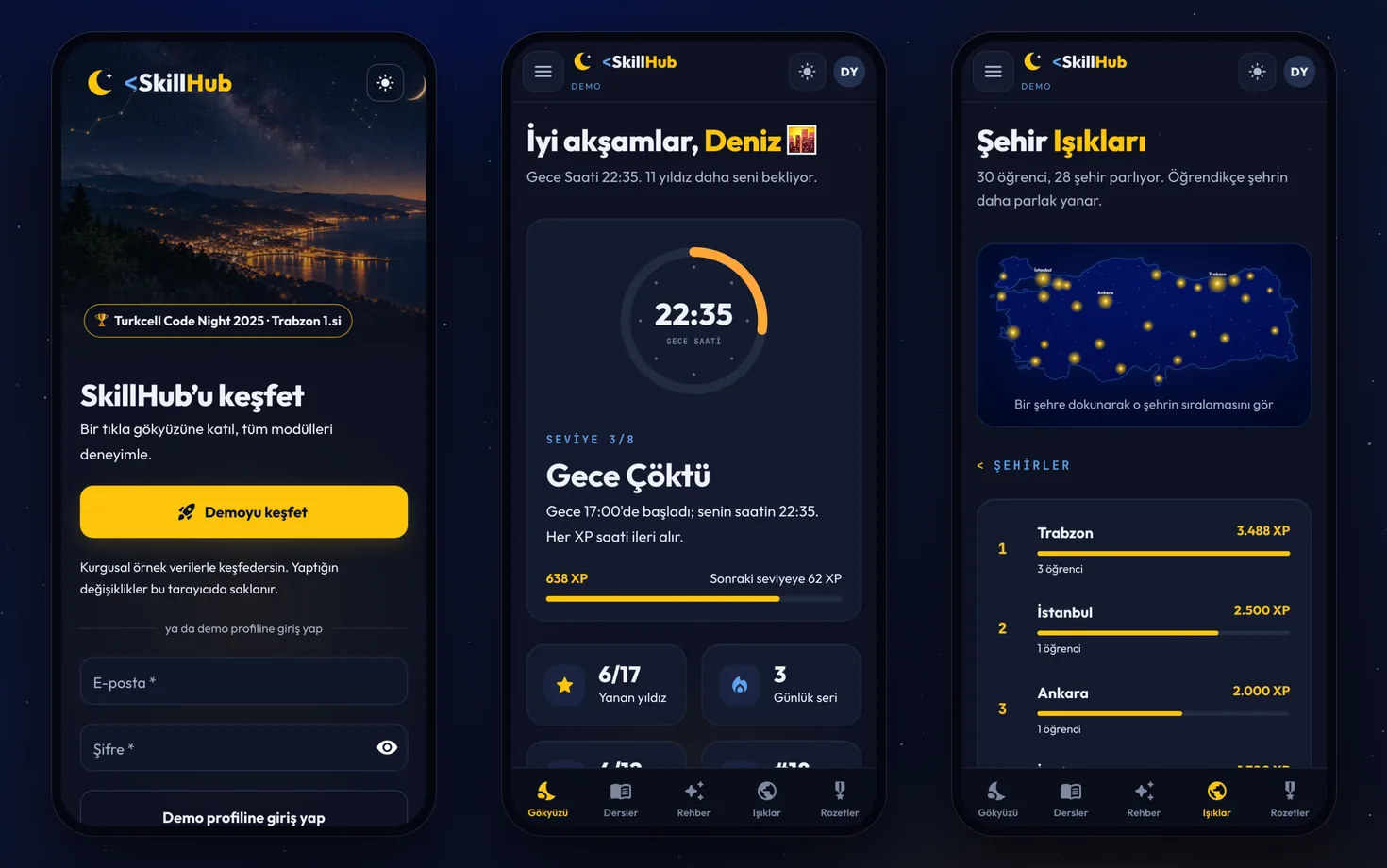
Phone interface: sign-in, the Night Clock and City Lights -
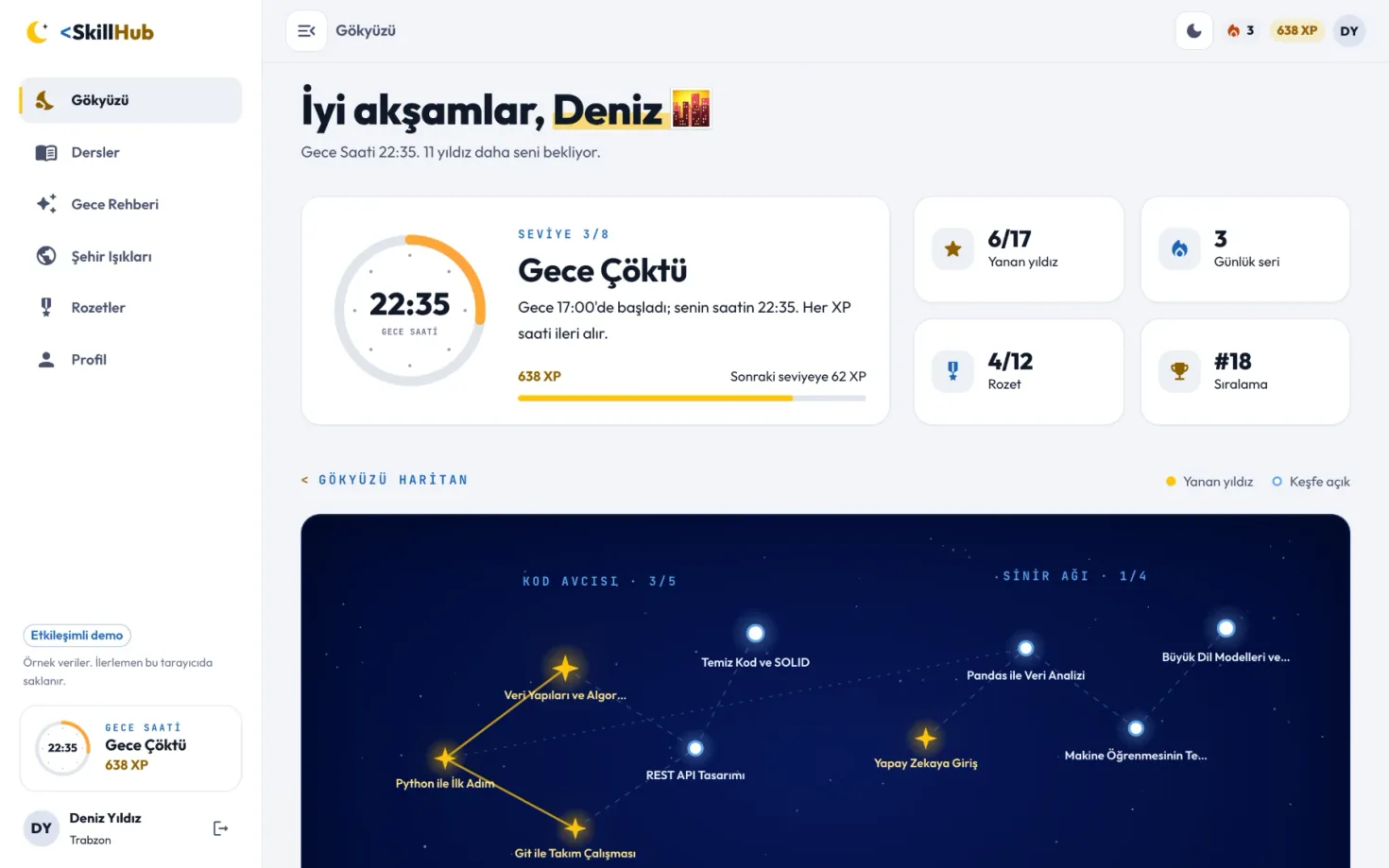
The light Şafak theme: the same screens in contrast-checked daytime colours -
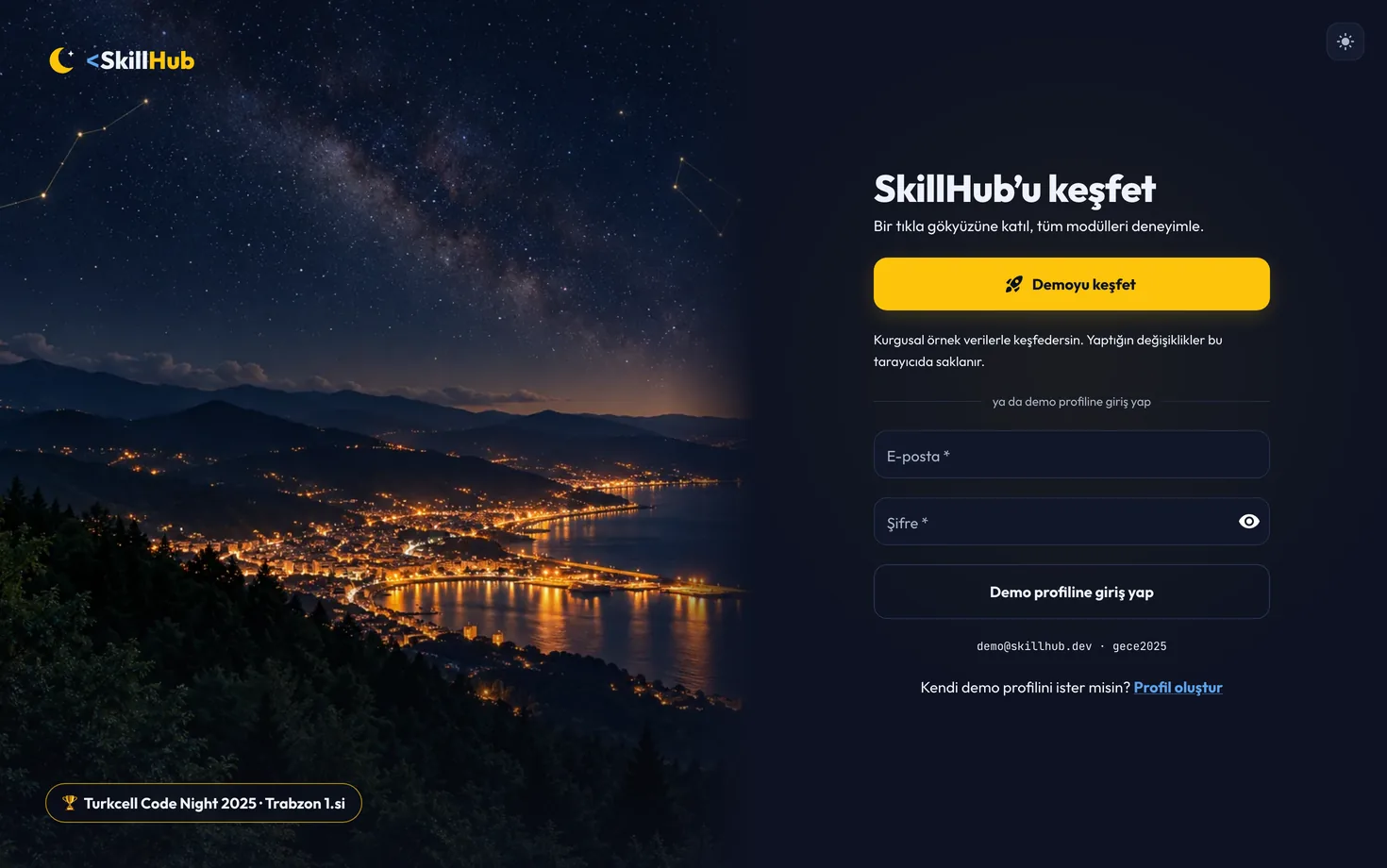
The live demo's sign-in page: one click opens a ready-made learner profile