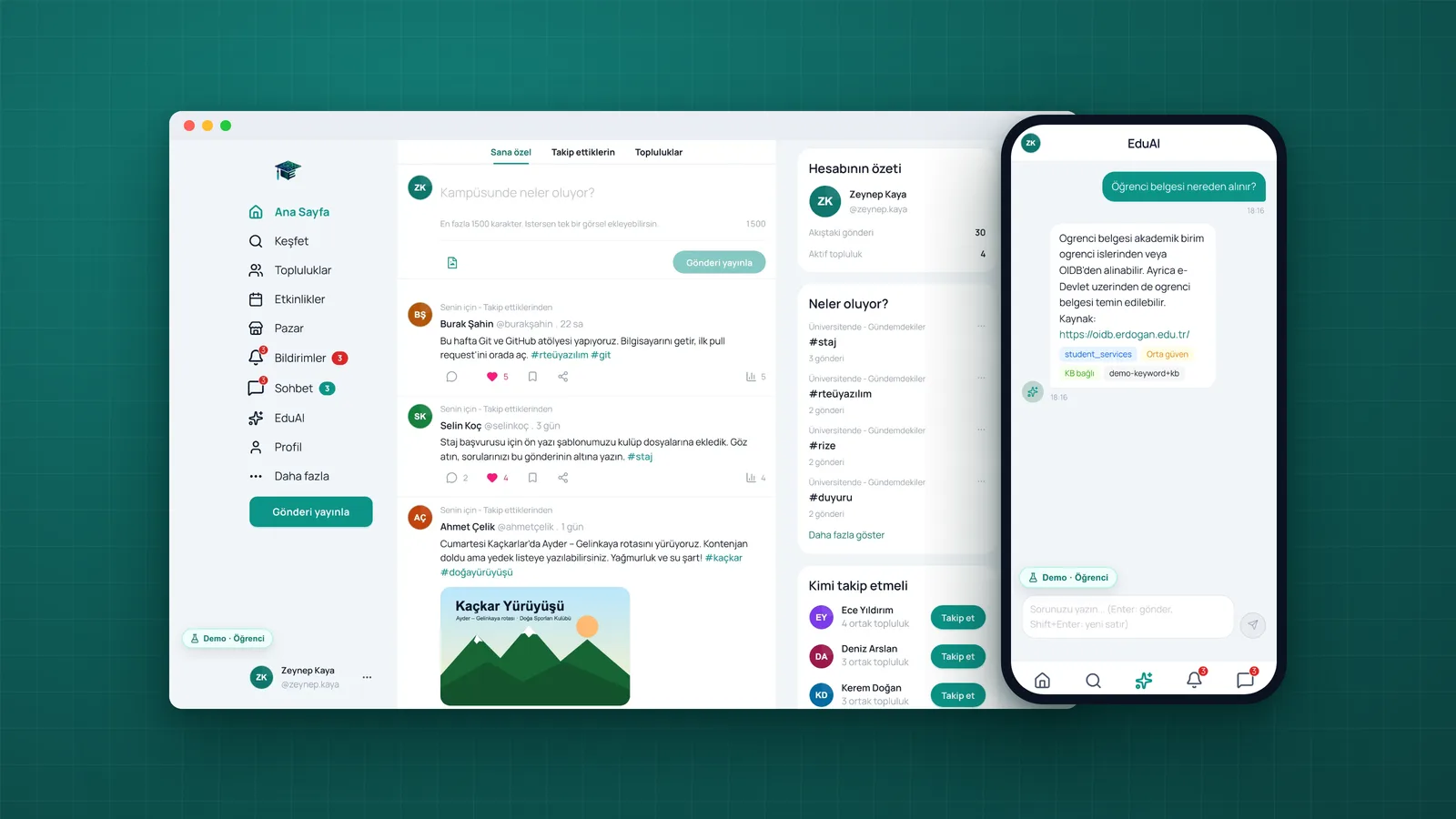
Graduation project supported by TÜBİTAK 2209-A Project
EduConnect
An AI-assisted campus platform with an assistant that shows its sources
A campus platform Ayşe Mandıralı and I built as our graduation thesis at Recep Tayyip Erdoğan University: a feed, communities, events, a second-hand market, messaging and EduAI, which answers university questions based on official sources. Behind it are an ASP.NET Core 10 API, PostgreSQL and a Python service that runs a BERTurk model. In the live demo you can log in with one of four roles in one click and try the feed, communities, EduAI, searching products with a photo and live messages.
- Technologies
- ASP.NET Core 10
- EF Core 10
- PostgreSQL 16
- SignalR
- FastAPI
- BERTurk
- PyTorch 2.5
- Gemini 2.5 Flash Lite
- React 19
- TypeScript 5.9
- Ant Design 6
- TanStack Query 5
- Docker
- My role Ayşe Mandıralı and I built the project as a two-person team for our graduation thesis in Computer Engineering at RTEÜ, and I was the team captain. We shared the work: the backend, the AI service, the frontend and deployment were our joint work. In November 2026 I reread the project from the start, built the live demo, fixed three bugs and wrote the documentation, checking it against the code. I wrote a significant part of the code with AI (Claude Code), under rules I set.
What I did
- In November I opened the live address and nobody could even log in: Render's free database had expired. I wrote a demo layer that answers the real API's contract in the browser. The axios adapter and the SignalR connection are swapped at build time, the screens stay the same, and the real build carries no trace of this code. For anyone who wants the real system, one command is enough: docker compose up --build.
- EduAI's value comes not from the model but from the system around it. A BERTurk model we fine-tuned on our own dataset sorts each question into one of 7 intents, a 412-entry knowledge base finds the answer, and Gemini puts it into the student's words. An answer only counts as grounded when the match is strong enough, and every answer shows its source link, intent and confidence band.
- The assistant answered some questions with “follow the announcements”; the problem was not the model but the data. We wrote a detector that catches short, deflecting answers, and in one day we grew the knowledge base from 225 to 412 entries using official PDFs such as the Student Handbook and university regulations.
- We assumed any external service could fail: if the NLP service does not answer, a safe fallback result takes over, and if Gemini's quota runs out, the local knowledge base does. In November I ran the system without a key and saw that this fallback never ran, because the service failed while it was being created. I fixed it, and today EduAI answers even without a Gemini key.
- The model's validation accuracy is 0.9626, but I do not oversell that number: the validation set comes from the same distribution as the training data, most of which was generated from rules. That is why we prepared a separate set of 60 hard cases. When the model's confidence is low, or its top two guesses are too close, the keyword classifier is consulted as well.
- We keep the refresh token in an HttpOnly cookie, single-use. Because the old token is revoked with a single UPDATE ... WHERE, the database settles the race even when two tabs refresh at the same moment, and the second request gets a clean 401. In the UI, requests that expire together share one refresh call.
- We trusted the database, not the application, with things that must happen only once: likes, bookmarks, follows and memberships. A second simultaneous request gets error 23505 from a unique index, and the backend reads it as “already done”. Counts come from rows, not from a separate counter, so they cannot inflate.
- In visual search, Gemini describes the photo while the NLP service extracts a 2,048-dimensional vector with ResNet-50. The two are combined into one score, and the API returns every result with a breakdown of category, text, condition, price and visual similarity, so the ranking stays explainable.
- Free tiers shaped the architecture. When the models did not fit into Render's 512 MB, we moved the AI into a separate service on Hugging Face; when the SMTP ports were blocked, we moved e-mail to Brevo's HTTPS API; and with no SQL Server available, we moved the database to PostgreSQL. In my November reread I found three more contract bugs, and I documented every decision with its cost in 12 documents in Turkish and English.
The problem
When we started university, it was hard to keep up with campus life: which event was where, which clubs existed, who could use a book we no longer needed, or who could take the make-up exam was scattered across many places. WhatsApp groups were chaotic, general social media had nothing to do with the university, and official announcements were buried in long PDFs.
What it offers
A student finds everything about campus in one place: a feed ranked for them that explains its choices, communities and events to follow, a market where products can be searched with a photo, and live messages. When they have a question about the university, EduAI answers and shows its source. Because signing up requires an institutional e-mail address, everyone on the platform really is a student.
-
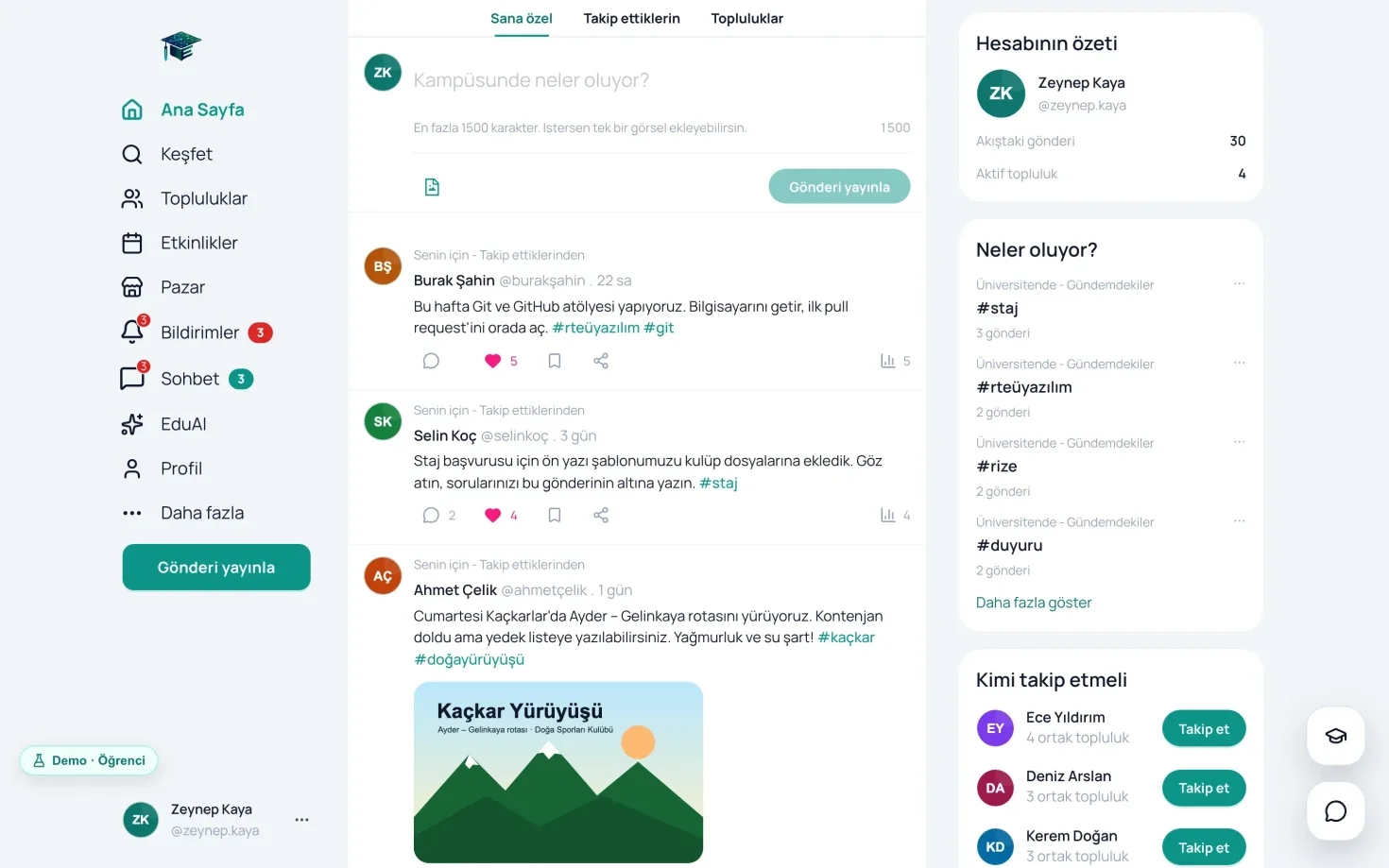
The personalized feed: every post says why it was recommended, with trending tags and follow suggestions on the right -
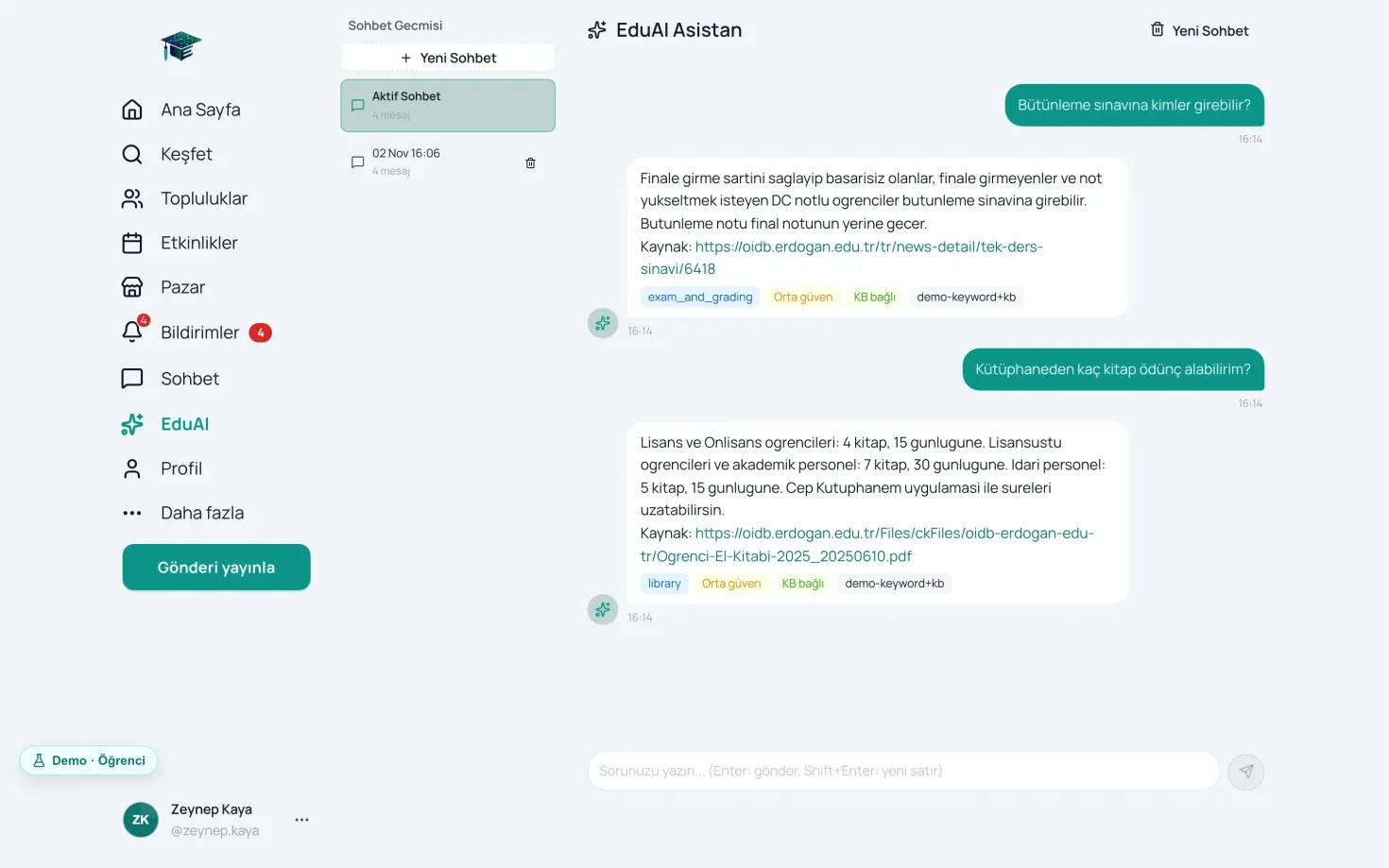
EduAI: answers about make-up exams and the library with official sources; each one shows the intent, confidence band and knowledge base label -
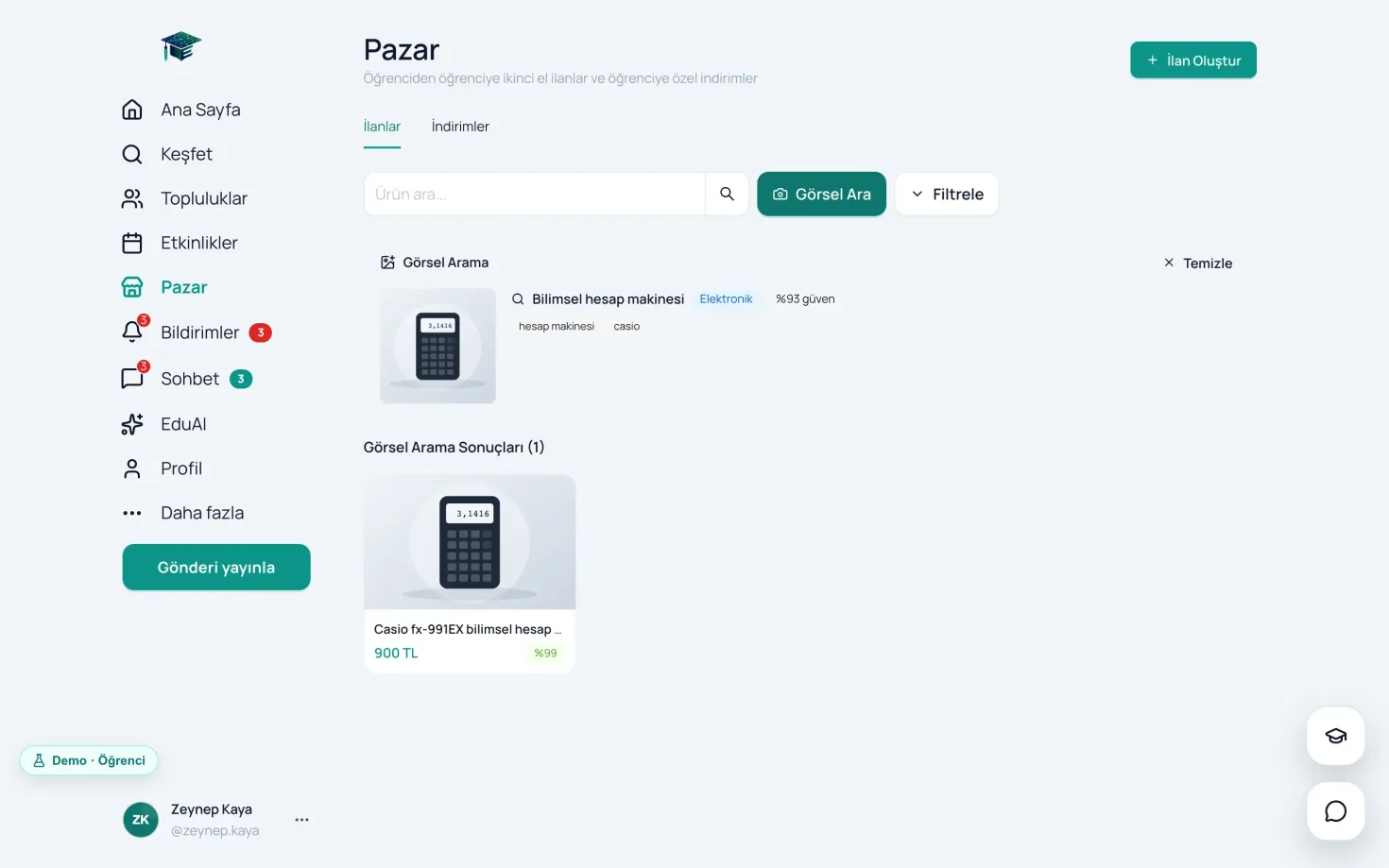
Visual search: the uploaded photo is recognized as a scientific calculator with 93% confidence, and the closest listing comes with its score -
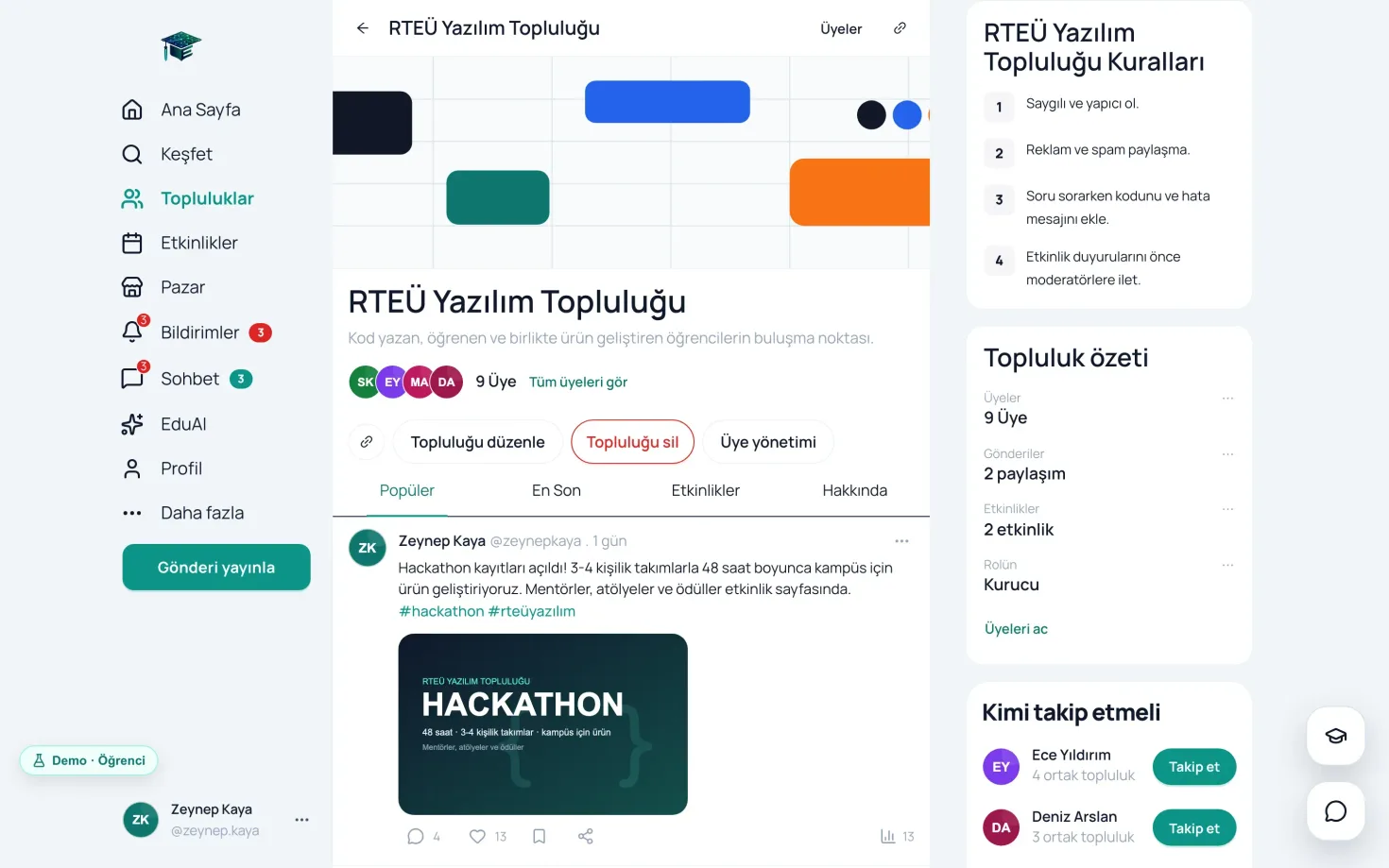
A community page: member management as the founder, the community rules and a summary -
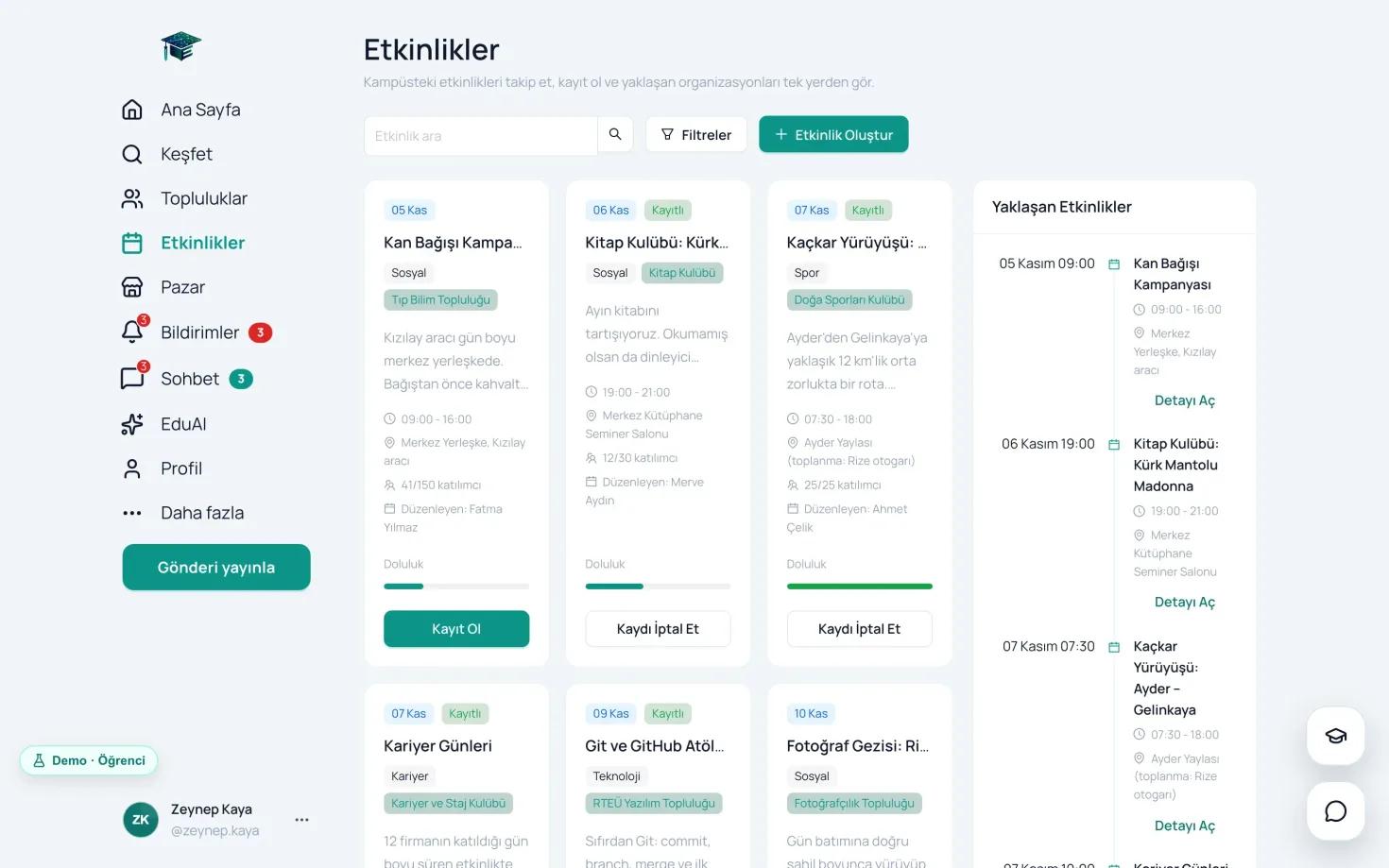
Events: capacity bars, registration and cancellation; the Kaçkar hike is full at 25/25 -
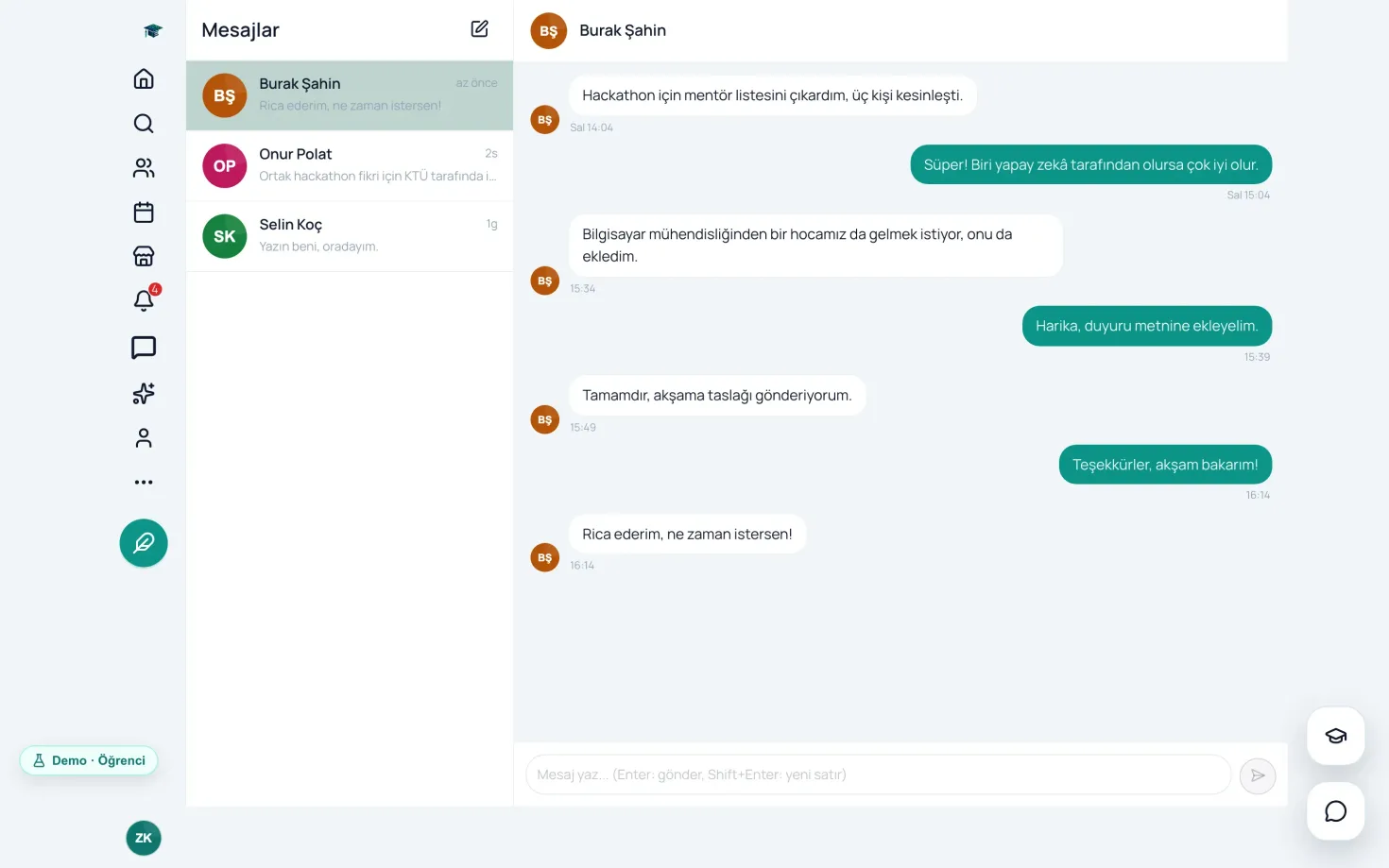
Direct messages: a reply arrives within seconds of sending a message -
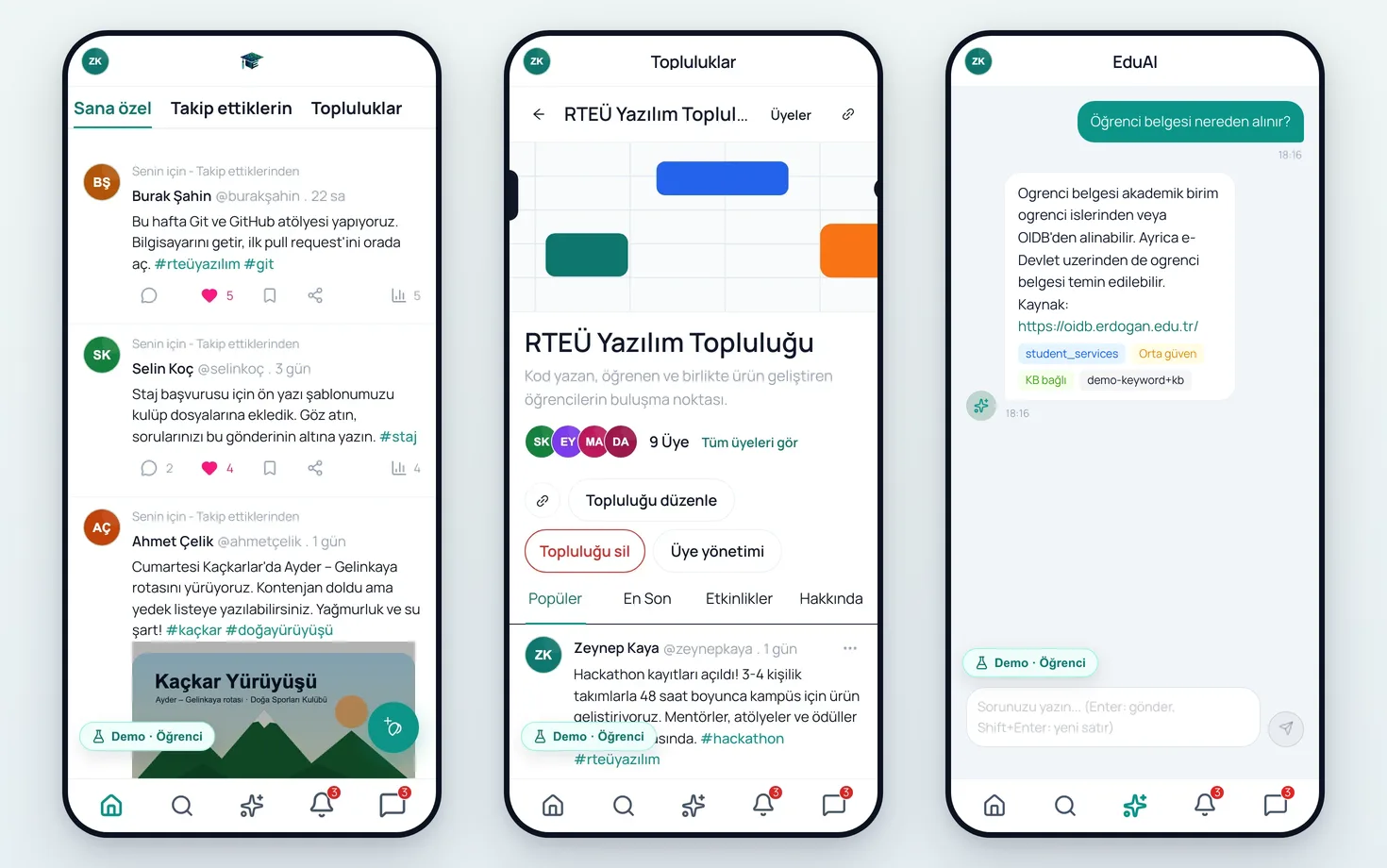
Phone interface: the feed, a community and EduAI, with a bottom navigation bar -
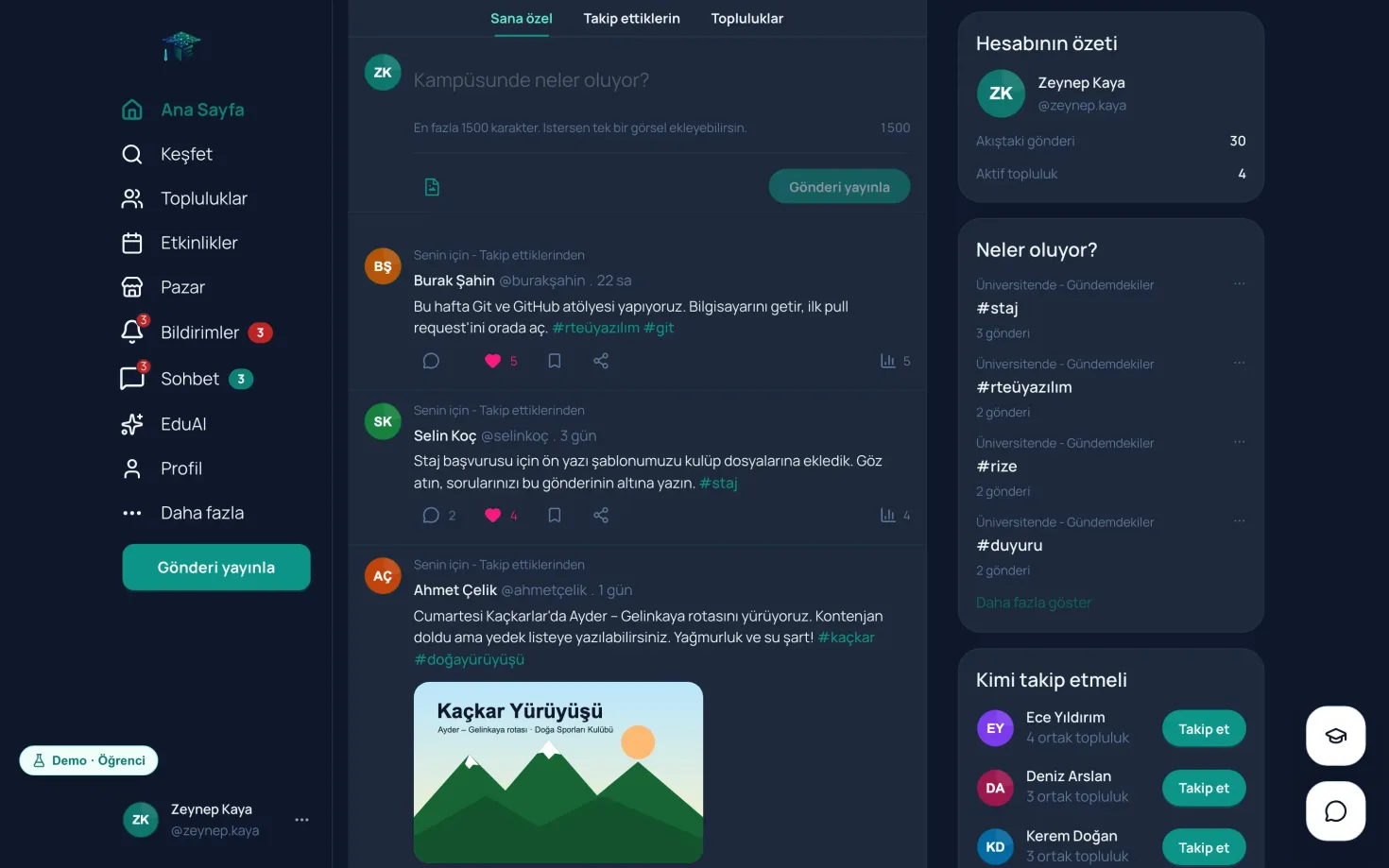
The dark theme: the same feed on deep navy rather than black -
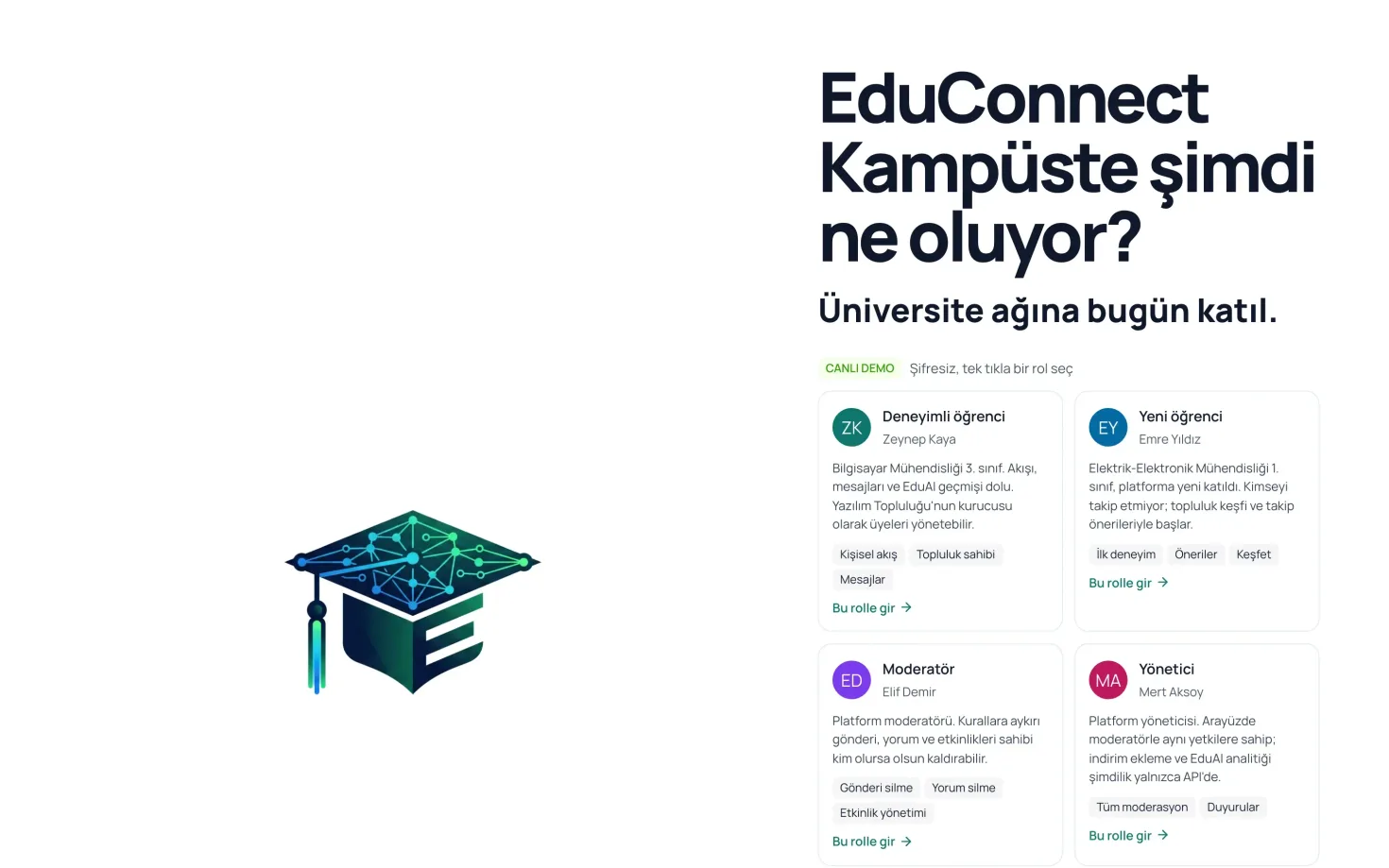
The live demo's landing page: one-click, password-free login with one of four roles